A Judge, a Service Dog, and a Question I Still Can’t Answer
Who Enforces the ADA? A Service Dog Handler’s Courtroom Story
Meta Description: A service dog handler describes being ordered to remove her service dog from a courtroom without question — and the confusing search for who actually enforces the ADA.
When ADA Violations Happen Somewhere You Don’t Expect
When most people think about ADA violations, they picture a restaurant refusing to admit a service dog or a store asking someone to leave.
My story happened in a courtroom.
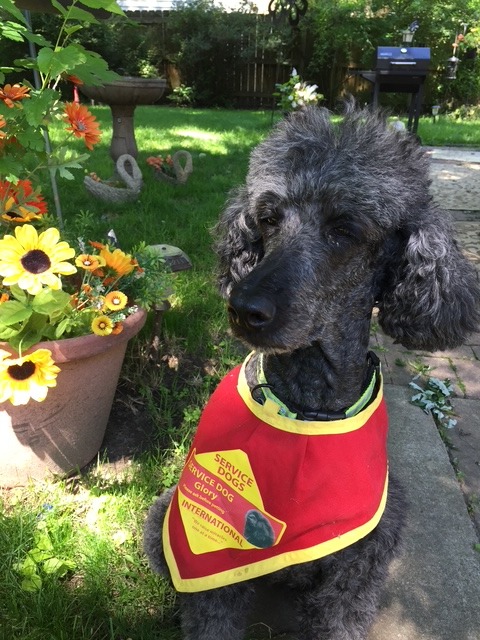
Years ago, my brother and I appeared in probate court during legal proceedings involving our father. I was accompanied by my service dog, Glory.
As soon as the judge saw Glory, he ordered me to remove her from the courtroom.
There were no questions.
He didn’t ask whether she was a service dog.
He didn’t ask what work or task she had been trained to perform.
He didn’t ask whether she accompanied me because of a disability.
He simply stated that the dog was inappropriate in the courtroom and ordered me to remove her.
When I tried to explain, the judge warned me that if I continued arguing, he would hold me in contempt of court.
My attorney quietly leaned over and suggested that I take Glory back to his office so the hearing could continue.
So I did.
Two Dogs, One Courthouse, One Standard
What made the situation even more confusing was that this wasn’t the first dog I had seen in that courthouse.
Another judge regularly brought his own pet dog to work.
The dog stayed in his chambers during the day, and because we were friends, I would occasionally stop by after court and pick the dog up for him.
It wasn’t a secret. This was a small town. People at the courthouse knew the dog was there, and several even commented about it after I was ordered to remove Glory.
From my perspective, two dogs had entered the same courthouse.
One was a pet. One was my service dog. Only one was ordered to leave.
Trying to File a Complaint — and Hitting Dead Ends
I left court frustrated, but more than anything, I wanted to know what I should do next.
I went to the local police department. The officer listened politely before telling me they couldn’t take a complaint against a judge. He suggested I contact the Civil Rights Commission instead and even gave me an address.
I drove there.
There was no Civil Rights Commission. There wasn’t even an office.
Now I was angry. So I went to the newspaper.
How a Few Words Changed the Story
The story made the front page.
Soon afterward, the judge issued a public statement explaining that bringing my service dog into court had been inappropriate because the matter involved “serious legal actions.”
Unfortunately, those few words changed the story.
Readers began writing letters to the editor saying that people “in trouble with the law” shouldn’t be allowed to bring dogs into court.
There was just one problem: I wasn’t in criminal court. I wasn’t accused of a crime. The hearing involved a family probate matter.
I asked the newspaper to publish that clarification. They refused.
For years afterward, I occasionally met people who remembered the article and assumed I had been in criminal court because of the way the story had been reported.
Eventually, someone from the Michigan Civil Rights Division contacted me and helped submit a complaint to the U.S. Department of Justice.
As far as I know, nothing ever came of it.
That experience left me with a question I’ve never completely answered: Who enforces the ADA?
What the ADA Actually Says About Service Dogs in Courtrooms
State and local government entities, including courts, are generally covered by Title II of the Americans with Disabilities Act.
When it is not obvious that a dog is a service animal, ADA guidance explains that staff generally may only ask two questions:
- Is the dog a service animal required because of a disability?
- What work or task has the dog been trained to perform?
In my case, those questions were never asked.
The Bigger Problem: Enforcement Isn’t Like Criminal Law
One of the biggest misconceptions about the ADA is that enforcement works like criminal law.
Many people assume that if their rights are violated, the police arrive, someone writes a citation, and the problem is resolved.
That wasn’t my experience.
Instead, I found myself moving from one office to another, trying to determine who — if anyone — had the authority to investigate what had happened.
Eventually, a complaint was forwarded to the Department of Justice. As far as I know, my complaint was never resolved.
That doesn’t mean the ADA isn’t important. It does raise a question that I think every service dog handler should consider: knowing your rights is one thing. Understanding how those rights are enforced — and what your practical options are when you believe they’ve been violated — is another.
If you believed your ADA rights had been violated tomorrow, who would you call? Would you know where to begin?
I thought I did. Now I’m not so sure.
Frequently Asked Questions
What two questions can staff legally ask about a service dog? When it isn’t obvious a dog is a service animal, staff may generally ask only whether the dog is required because of a disability and what task or work it has been trained to perform. They cannot ask for documentation, require a demonstration, or ask about the handler’s specific disability.
Can a judge or courtroom deny access to a service dog? Courts, as state and local government entities, are generally covered under Title II of the ADA and are expected to permit service dogs under the same standards as other public entities. A blanket refusal without asking the two permitted questions raises the kind of enforcement questions described in this story.
Who do you file a complaint with if your ADA rights are violated? Complaints can typically be filed with the U.S. Department of Justice, a state civil rights division, or in some cases through a private lawsuit. As this story illustrates, the process is often unclear, inconsistent, and can take a long time — if it resolves at all.
What should I do if I believe my ADA rights were violated? Document the incident immediately, get names and witness information if possible, and file a complaint with your state civil rights office and the Department of Justice. Consider contacting a disability rights attorney or advocacy organization if the situation isn’t resolved.
SEO Notes (for your reference — remove before publishing)
Primary keyword: ADA service dog rights / service dog courtroom rights Secondary keywords: who enforces the ADA, ADA violation complaint, service animal two questions, Title II ADA courts, service dog denied access
Suggested title tag (under 60 characters): “Service Dog Denied in Court: Who Enforces the ADA?”
Suggested URL slug: /service-dog-denied-courtroom-ada-enforcement
Suggested meta description (under 155 characters): “A service dog handler was ordered out of a courtroom with no questions asked. Her story exposes a major gap in ADA enforcement.”