
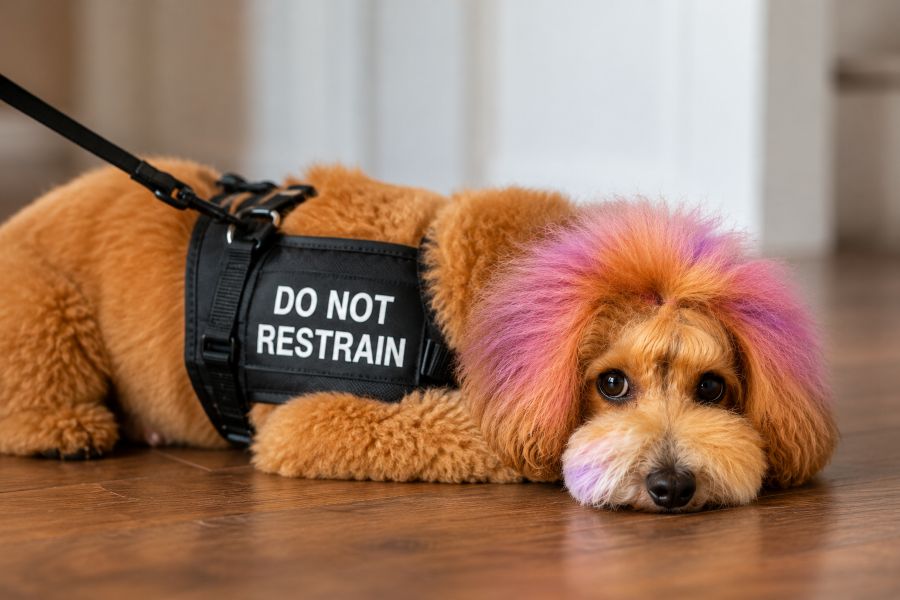
If you ask Sunday what her least favorite thing in the world is, the answer isn’t the vacuum cleaner or the veterinarian.
It’s being restrained.
The moment someone reaches for her leash, collar, or grooming loop, everything changes. The happy, tail-wagging little clown suddenly becomes cautious. She pulls away, plants her feet, or tries to escape.
It isn’t stubbornness.
It’s association.
For Sunday, being physically restrained has almost always meant that something unpleasant was about to happen.
The veterinarian grabs her leash before vaccinations, blood draws, or examinations.
The groomer takes hold of her leash before leading her into the grooming area, where she is placed in a grooming loop and asked to stand still for what must seem like forever.
Even routine handling has taught her that restraint often comes before experiences she doesn’t enjoy.
From Sunday’s perspective, the pattern is perfectly logical.
Someone grabs the leash.
Something unpleasant follows.
Dogs are incredibly good at making these associations.
Fortunately, they are also capable of creating new ones.
Today, every time I gently take Sunday’s leash without anything unpleasant happening, we create a new experience. We practice short periods of restraint followed by praise, treats, play, or simply continuing our walk.
Little by little, we are teaching her that being restrained doesn’t always predict something scary.
It predicts life.
Sometimes it means we’re going for a walk.
Sometimes it means we’re heading into an agility class.
Sometimes it means we’re visiting friends.
Sometimes it simply means we’re going together.
As service dog trainers, we often focus on teaching commands and public access skills. But equally important is understanding how our dogs experience the world.
They aren’t reacting to the leash.
They’re reacting to what the leash has meant in the past.
The lesson isn’t just about Sunday.
It’s a reminder that behavior almost always has a story behind it.
If we take the time to understand that story, we can replace fear with trust—one positive experience at a time.