
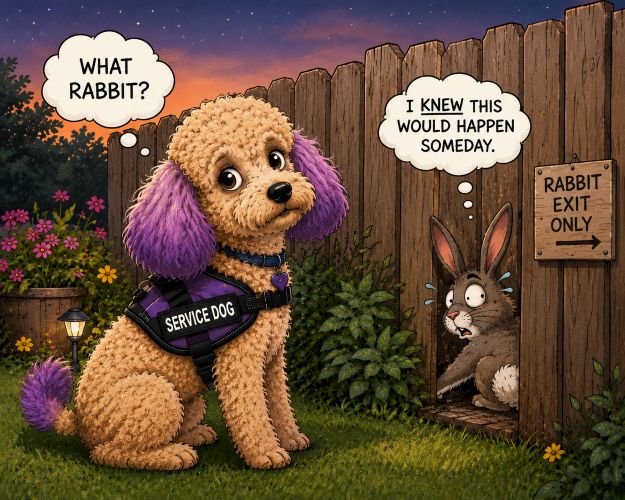
It was about ten o’clock one evening when I heard Izzy making a commotion.
Now, Izzy isn’t exactly known for overreacting. At eight years old, she has perfected the art of conserving energy. If she’s making noise, something is probably worth investigating.
I stepped outside and found Sunday proudly standing at the fence.
On the other side of the fence was a very unhappy rabbit.
Sunday had managed to catch it by the leg, and the rabbit was desperately trying to squeeze through the fence to escape. As soon as I realized what was happening, I yelled.
I don’t yell very often.
Apparently, Sunday didn’t know I could.
She looked at me with complete surprise, dropped the rabbit, and it disappeared into the darkness as fast as only a rabbit can.
The next morning, I couldn’t help but laugh.
Not because Sunday had caught a rabbit—I certainly wasn’t thrilled about that—but because it reminded me how often we forget what our dogs were originally bred to do.
Most people look at Sunday and see a fluffy little toy poodle with a fancy haircut and purple hair.
They don’t see a hunter.
But long before poodles became stars of the show ring, they were working dogs. The breed originated in Germany, where poodles were developed to retrieve waterfowl. In fact, the word “Pudel” comes from the German word meaning “to splash in water.”
That famous poodle clip wasn’t created because someone thought it looked fashionable. It originally protected the dog’s joints and vital organs while allowing freedom of movement in cold water.
Sunday doesn’t know any of that history.
She doesn’t know she’s supposed to look elegant.
She just knows that something small moved across the yard.
And somewhere, deep inside generations of selective breeding, her instincts said,
“Go get it.”
Every breed has a story like that.
Terriers were developed to hunt vermin. Don’t be surprised when they dig, chase squirrels, or investigate every hole in the yard.
Border Collies were bred to gather livestock. Many spend their lives trying to organize children, bicycles, or even the family cat.
Retrievers naturally want to carry things. If your Labrador proudly delivers one shoe from every pair to the middle of the living room, he’s probably convinced he’s helping.
Guardian breeds were developed to watch over their families and property. It’s part of what made them valuable for centuries.
These behaviors aren’t flaws.
They’re history.
One of the biggest mistakes people make when choosing a dog—especially a future service dog—is choosing with their eyes instead of their understanding.
We fall in love with appearance, size, or popularity without asking a simple question:
What was this dog originally bred to do?
That question doesn’t tell you everything about an individual dog.
Personality, early socialization, health, and training all matter tremendously.
But understanding a breed’s history gives you valuable insight into the instincts you’re likely to live with for the next ten to fifteen years.
The same principle applies to mixed breeds.
Mixed-breed dogs can make wonderful companions and, in some cases, excellent service dogs. The challenge isn’t that they’re “better” or “worse.” It’s that predicting which inherited traits will emerge can be more difficult than with a long-established breed that has generations of selection for consistent characteristics.
That’s one reason thoughtful evaluation is so important when selecting a service dog prospect.
You aren’t choosing a haircut.
You aren’t choosing a color.
You aren’t even choosing a breed.
You’re choosing the behaviors, instincts, and temperament that you’ll spend years shaping into a working partnership.
As for Sunday?
She’s still the same happy, affectionate little clown who believes every stranger is her newest best friend.
She’s also a reminder that beneath the fluffy haircut is a dog whose ancestors had a job to do.
Fortunately, rabbits are much faster than I am.
And after that evening, I suspect Sunday learned that if she catches one again, she’d better hope I don’t discover her first.
The lesson isn’t that dogs should stop being dogs.
The lesson is that the more we understand what our dogs were bred to do, the better prepared we are to help them succeed in the jobs we ask them to do today.