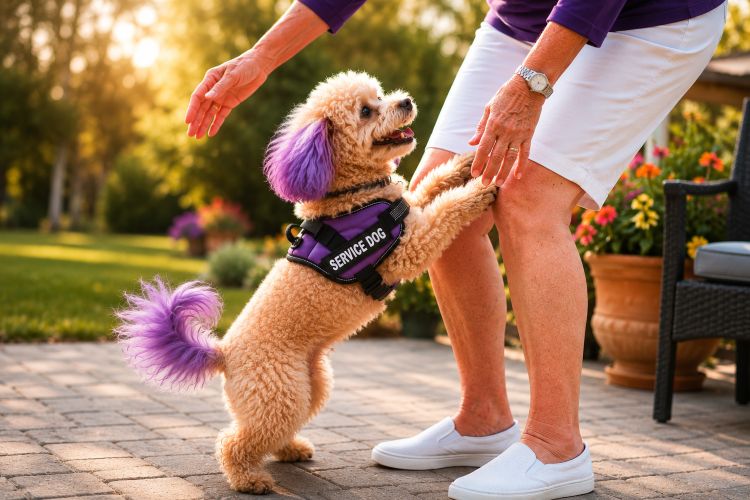
If Sunday had her way, every person she met would become her newest and best friend. She doesn’t care whether you’re the mail carrier, the cashier at the grocery store, or a neighbor stopping by to say hello. If you smile at her, she assumes you came just to see her. It’s one of the things I love most about her. Unfortunately, it’s also one of the behaviors we have to change before she can become a reliable service dog.
Sunday’s biggest challenge isn’t learning commands. It’s learning self-control. Whenever our neighbor Chris visits, Sunday becomes so excited that she jumps repeatedly to greet her. I tell her “Off,” and she listens—for about thirty seconds. Then Chris starts talking with her hands, shifting her weight as she speaks, and suddenly Sunday’s excitement returns. To Sunday, every movement looks like another invitation to play.
One afternoon we were sitting by the lake when Sunday jumped again. Chris stepped backward to avoid her, lost her balance, and fell. Because she has had two knee replacements and a hip replacement, she couldn’t get up without her husband’s help. Sunday didn’t knock Chris over. She wasn’t being aggressive or intentionally misbehaving. But her excitement contributed to a situation that resulted in someone getting hurt.
That afternoon reminded me of one of the most important lessons I learned while operating a service dog agency.
People often assume that dogs fail service dog training because they can’t learn the work. In my experience, that wasn’t usually the case. Many dogs were intelligent enough to perform advanced tasks. They could retrieve dropped items, learn complex commands, and solve training problems with surprising ease. The reason many dogs did not complete the program had little to do with intelligence and everything to do with behavior.
A service dog must remain calm around strangers, ignore distractions, walk politely through crowded public places, settle quietly in restaurants, and make good decisions even when life becomes exciting. These aren’t simply “good manners.” They are essential working skills. Without them, the most impressive task training in the world has very little value.
That’s why I believe behavior is a task.
In fact, it may be the most important task a service dog ever learns. Before a dog can safely retrieve medication, open a door, or provide mobility assistance, the dog must first demonstrate emotional stability, impulse control, and reliable public behavior. Those qualities form the foundation on which every other skill is built.
Sunday reminds me of this lesson almost every day. She is bright, eager to learn, and she genuinely loves people. Those are wonderful qualities in a companion dog. But before I can ask her to help someone else, I have to teach her that excitement never takes priority over self-control.
Whether a dog comes from a breeder, a rescue organization, or another source, every prospective service dog deserves a careful evaluation of temperament and behavior before advanced training begins. Task training can build skills, but it cannot replace the stable foundation required of a working dog.
When people think about service dog training, they often imagine teaching specialized tasks. In reality, the work begins much earlier. It begins with building a dog whose behavior is so dependable that people hardly notice the dog at all.
Because the most important task a service dog performs isn’t opening doors or retrieving keys.
It’s behaving like a service dog every single day.